 Datum Machine
Datum Machine
Datum Machine
Manufacturing is becoming more connected, measurable, and demanding. Deloitte’s 2023 Global Smart Manufacturing Survey found that 86% of manufacturing leaders expect smart factory initiatives to strengthen competitiveness within five years. Another 83% believe these systems could transform production. These figures explain why laser cutting deserves closer attention.
So, what role does laser cutting play in smart manufacturing? It is no longer only a method for producing clean edges. A connected laser cutter can read digital work orders, adjust power, record operating data, and send results to a manufacturing execution system. Sensors can monitor nozzle condition, thermal behavior, and cutting stability. Operators may then identify defects before a full batch is wasted. On a factory floor, this could mean fewer rejected steel panels, clearer traceability, and faster changeovers.
Peter Leibinger, a former TRUMPF technology leader, has described connectivity as “the key to increasing productivity in manufacturing.” His view reflects an important industry reality. Laser equipment becomes genuinely smart only when machines, software, materials, and people exchange reliable information. The World Economic Forum’s Global Lighthouse Network has also reported major gains in productivity, quality, and lead times from digitally integrated production sites.
The picture is not perfect.
Many factories still operate older machines, incomplete databases, or disconnected software. A sensor cannot repair poor planning. Automation also creates training pressures for technicians and operators. This article examines how laser cutting supports flexible production, predictive maintenance, real-time quality control, and resource efficiency. It also questions where the technology falls short, because smart manufacturing should improve decisions, not merely add more data.
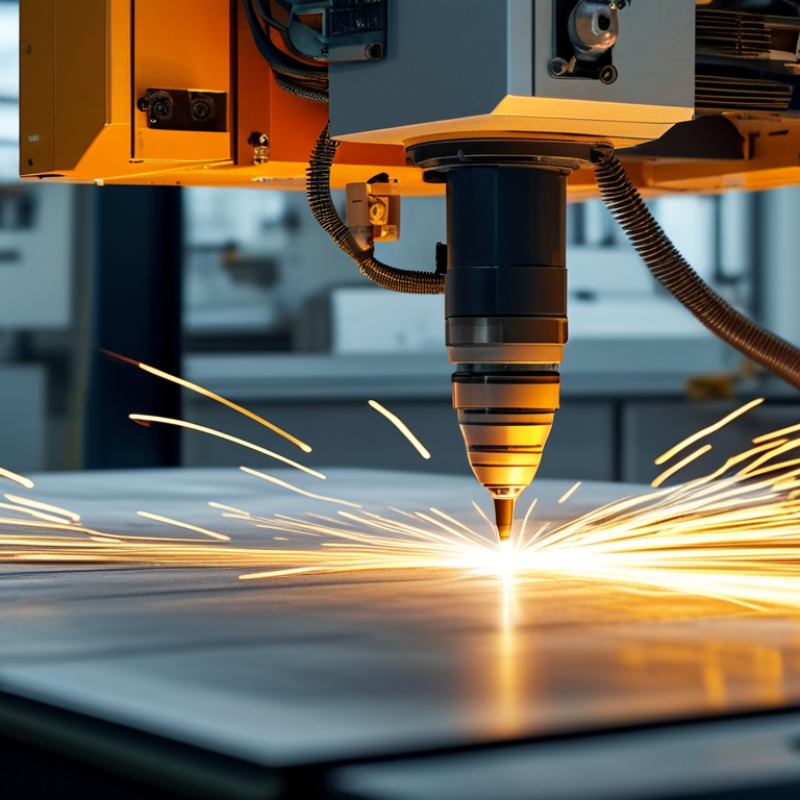
Understanding laser cutting in smart manufacturing starts with its connection to digital production systems. A laser head follows coded paths, while sensors monitor power, speed, gas flow, and material position. This creates precise edges on sheet metal, even when product dimensions change frequently. The process is highly repeatable. Operators can review production data before the next batch begins. That visibility reduces guesswork. Errors still happen.
In a connected factory, laser cutting communicates with planning, inspection, and inventory software. A design file can move from engineering to production with fewer manual transfers. Automatic nesting limits unused material, while camera-based inspection can flag burrs, discoloration, or incomplete cuts. In practice, small calibration errors still matter. A dirty lens or unstable gas supply may affect hundreds of parts. Smart equipment does not remove responsibility. Skilled technicians remain essential for setup, maintenance, and judgment.
The strongest value appears when data supports practical decisions. Teams can compare cycle times, detect rising energy use, and schedule maintenance before quality declines. Traceable records also support consistent audits and customer requirements. However, connectivity can expose weak data controls and confusing workflows. Not every factory needs full automation. A smaller cell with reliable monitoring may outperform a complex system poorly maintained. Data needs context. Laser cutting becomes genuinely smart when accurate inputs, disciplined procedures, and human review work together.
| Dimension | Typical Data or Range | Contribution to Smart Manufacturing | Practical Considerations |
|---|---|---|---|
| Core manufacturing role | Non-contact, digitally programmed cutting of sheet, plate, tube, and selected three-dimensional components | Connects computer-aided design, production planning, machine control, inspection, and production data in one workflow | Requires accurate digital drawings, suitable process parameters, and controlled material quality |
| Common laser sources | Fiber, carbon dioxide, and solid-state lasers; fiber lasers commonly operate near a 1 micrometre wavelength | Enables automated selection of cutting strategies for different metals, thicknesses, and production targets | The laser type must match the material, thickness, reflectivity, assist gas, and required edge quality |
| Compatible materials | Carbon steel, stainless steel, aluminum, copper and brass within process-specific limits; some systems also process plastics, wood, and composites | Supports mixed-product manufacturing and rapid changeover without dedicated mechanical tooling | Reflective metals and heat-sensitive non-metals require specialized settings, optics, extraction, and safety controls |
| Typical material thickness | Approximately 0.5–25 mm for many industrial sheet-metal applications; the practical limit depends on laser power and material | Allows production software to assign jobs according to machine capability, material inventory, and delivery priority | Maximum thickness is not universal; cutting speed and edge quality generally decrease as thickness increases |
| Dimensional capability | Typical production tolerances are often around ±0.05–±0.20 mm, depending on material, thickness, machine, and part geometry | Creates repeatable digital-to-physical results that can be monitored through automated inspection and statistical process control | Tolerance values must be confirmed through capability studies rather than assumed for every job |
| Cutting speed | Ranges from a few hundred millimetres per minute on thick plate to several metres per minute on thin sheet | Provides measurable cycle-time data for scheduling, bottleneck analysis, and production-cost estimation | Actual speed depends on laser power, material grade, thickness, assist gas, piercing time, and contour complexity |
| Programming and data flow | CAD/CAM files are converted into machine programs with nesting, toolpath, piercing, and process parameters | Creates traceability from design revision to finished part and reduces manual data entry | File version control, access permissions, and standardized post-processors help prevent programming errors |
| Automation level | Manual loading can be combined with automatic nesting, pallet changing, material storage, unloading, sorting, and part identification | Supports lights-out or low-attendance production for suitable jobs and improves machine utilization | Automation is most effective when material standards, job sequencing, and downstream handling are also organized |
| Sensor and monitoring inputs | Nozzle height, autofocus position, assist-gas pressure, reflected light, temperature, vibration, power, and machine status | Enables real-time condition monitoring, fault detection, adaptive control, and process traceability | Sensor data must be calibrated, time-stamped, and linked to the correct job and material batch |
| Quality inspection | Dimensional checks, edge-quality assessment, burr detection, visual inspection, and automated camera-based verification | Moves quality control from end-of-line detection toward early warning and closed-loop improvement | Inspection criteria should reflect functional requirements, not only visual appearance |
| Material utilization | Nesting software commonly reduces avoidable scrap by arranging parts within the usable sheet area; results vary by geometry and order mix | Uses order data and inventory information to balance yield, delivery time, remnant reuse, and material cost | Small parts, grain direction, edge margins, heat concentration, and remnant tracking affect nesting efficiency |
| Energy and resource management | Power consumption varies with laser type, rated power, duty cycle, cutting speed, assist gas, cooling, and idle time | Machine data can identify idle periods, abnormal consumption, gas leakage, and opportunities for optimized scheduling | Energy comparisons should use measured consumption per part or per kilogram, not laser rating alone |
| Predictive maintenance | Maintenance indicators include nozzle wear, lens contamination, filter loading, chiller status, vibration, and cutting-quality drift | Uses historical machine data to schedule service before failures interrupt production | Predictive models need sufficient historical records and must be combined with technician inspection |
| Manufacturing performance indicators | Overall equipment effectiveness, cycle time, utilization, first-pass yield, scrap rate, downtime, gas use, and rework rate | Turns machine activity into comparable operational data for continuous improvement and capacity planning | Metrics should use consistent definitions and exclude misleading averages caused by different job mixes |
| Integration with factory systems | Can exchange job, inventory, status, quality, and maintenance information with production planning, manufacturing execution, and enterprise systems | Provides a connected production loop from customer order and material allocation to machine execution and reporting | Interoperability, cybersecurity, data ownership, and reliable network connectivity are essential |
| Workforce impact | Operators increasingly supervise programs, material flow, process data, quality exceptions, and maintenance alerts | Shifts human effort from repetitive machine operation toward process control, troubleshooting, and data-based decisions | Training is required in laser safety, CAD/CAM, materials, quality standards, and automated equipment |
| Main smart-manufacturing value | Flexible production, repeatable quality, reduced setup time, improved traceability, faster feedback, and more informed resource use | Laser cutting acts as a data-rich, digitally controlled production node rather than an isolated cutting machine | Benefits depend on process standardization, data accuracy, equipment integration, worker capability, and continuous improvement |
Note: The figures shown are representative industrial ranges. Actual performance depends on machine configuration, laser power, material grade, thickness, assist gas, part geometry, and process settings.
: It connects cutting equipment with design, planning, inspection, and inventory systems. Sensors monitor power, speed, gas pressure, and sheet position. The machine follows coded paths. Errors still happen.
Useful data includes cycle time, cutting speed, power, temperature, gas pressure, and material position. Maintenance records and inspection results also matter. Missing records weaken decisions.
Automatic nesting places parts closely on each sheet. This reduces unused material and supports more consistent planning. Operators can compare scrap rates across batches. The result is not always better.
Yes. Design files can move into production with fewer manual transfers. The system can record settings, processing history, and inspection results. This reduces typing mistakes. It does not remove responsibility.
Sensors can reveal unstable gas pressure, rising temperature, or unusual cycle times. These signals may appear before rough edges or incomplete cuts. Operators can inspect a sample part and adjust approved settings. Small signals matter.
A dirty lens, drifting sensor, warped sheet, or unstable gas supply can affect many parts. Poor material codes may also corrupt production data. A healthy dashboard can still hide a failed process.
No. A smaller cutting cell with reliable monitoring may perform better. It may use fewer sensors and simpler workflows. Complex systems require disciplined maintenance. More automation is not automatically smarter.
Technicians set parameters, maintain equipment, inspect sample parts, and judge unusual results. They also record corrective actions and review alerts. Human review remains essential. Software can be confidently wrong.
Start with one repeatable workflow, such as nesting, machine feedback, and inspection records. Measure scrap, changeover time, and rework for several weeks. Then improve the workflow using evidence. The uncomfortable answer may be poor process discipline.
What role does laser cutting play in smart manufacturing? It serves as a precise, flexible, and highly connected production method that supports modern digital workflows. By integrating laser cutting equipment with design software, production management platforms, and automated material handling systems, manufacturers can transfer digital instructions directly to the cutting process. This connection reduces manual setup, improves consistency, and allows production teams to respond quickly to changing product requirements.
Laser cutting also improves manufacturing efficiency by delivering accurate results at high speeds while minimizing material waste. Sensors and data collection tools can monitor cutting quality, equipment performance, energy use, and maintenance needs in real time. This information helps operators optimize settings, predict potential problems, and maintain stable output. However, smart laser manufacturing still requires skilled personnel, reliable data integration, equipment maintenance, and strong cybersecurity practices. When these challenges are addressed, laser cutting can become an important foundation for more efficient, flexible, and intelligent production.
